Showing posts with label Personal. Show all posts

Thursday, October 24, 2013


Father Playing A Guitar

This smile I never saw before: as if the lips
Are keeping a secret to itself. It makes both eyes
Rise up at the edges, pushing the brows into
Gentle arches. Wide forehead is out of place
In this young body but the hands, the hands
Curve around the guitar and the fingers
Curl over strings in a most familiar manner
Such that I could almost hear the music. As if
Everything in this picture--the vines, the dog
Lying on the ground in a half O,
The wide, palm-shaped leaves, you--
Are wonders that I could see and touch again.

Monday, October 14, 2013

Who am I to think I’m so special?

“It all ends in tears anyway.”
- Jack Kerouac

We take what we can, those few moments of passion
Leaving our children at home with Legos and biscuits
And running to the mall to get his favorite sandwich
And hard drink, investing more than our hearts
Into Facebook relationships. Waiting at 4:00 a.m.
For some activity so we could say Hello, pretend
We just woke up and are bright-eyed when the truth
Is that we are loving with one hand over our hearts,
The other stroking his ear, his penis,
His ego. Like fragile porcelain dolls our eyes
Are wide and hopeful in the beginning, and even
Right before it ends. Even when we realize
We are not named: No labels, no nothing.
And yet when it all comes crashing down we just
Cry in tiny, painful trickles.

Let us love when the time is right. Oh, how we know
In our most secret hearts, how we know we deserve
So much better. In the meantime, we heal our wounds with
Love songs, belted loudly, inside lonely KTV rooms
Somewhere in this noisy, dirty city, full of double-dealing
boys. Boys, really. Only with beer bellies and salt
And pepper hair. My stomach turns.

So go ahead and chug down your Smirnoff, you beautiful,
Luminous shock of a woman. Wear your attitude like a blazing
Crown. You are very special. Light up the room
With your magnificence. You rock and you roll.
Janis Joplin cannot hold a candle to you.


Wednesday, August 28, 2013

Consultation

Every time I visit my doctor, strange things happen. Today I walked through the front doors and I saw him getting ready to take some tea and biscuits with two other men. One was a driver, the other one a young Indian priest. I joined them and the priest handed me his cup of tea. We started talking about ways to help balding men grow their hair back. We also touched on mental illness and writing for a bit. Our young priest, apparently, had taken a liking to the written word and so took the opportunity to ask me a few questions about my work. After they left, my doctor and I talked about the proper way to take the medicines. I have probably heard it a hundred times, but I listened and we laughed and... got interrupted by screaming. One of his assistants, a lady I have grown fond of, was reprimanding another assistant at the top of her lungs. They were summoned into the consultation room, all four assistants, and the issue was assessed, discussed, addressed inside. I sat there with my cold tea, in the middle of a "domestic" crossfire. I had a meeting and needed to rush, but I had to wait until things were settled and apologies were offered all around like bread at dinner time. As an afterthought, I was given my packet of drugs. I put my money inside a white envelope and quickly walked out of the clinic, rushing to a nearby restaurant for some soup, pizza and apple cooler.

Saturday, July 13, 2013

Rethinking volunteerism


I think it was 2009 when I dove head on to a life that was primarily consumed by volunteer work. I started a children’s organization, Isang Bata, because I needed to channel negative emotions into something constructive and positive, and also because I wanted to help children, seeing how my own son was growing up. There were numerous projects under Isang Bata, including partnerships with various individuals and institutions. The most recent happened only last month.

I volunteered my time, ideas, strength, resources and skills for at least six other organizations, but the ones that presently ask a lot from me are my BOD responsibilities in my son’s school and my Executive Committee duties for the Freelance Writers’ Guild of the Philippines (FWGP), which I also founded a couple of years ago. I also recently took on a magazine editing job, gratis et labore, for my favorite doctor, not knowing that, although I truly love him as a doctor and friend, he’d be such a nightmare to work with.

As I have been doing this for more than four years, which is no joke considering that perhaps half (or even more) of my working hours is spent on volunteer work, I know that this is not a good place to go if one is merely looking for fulfillment. Meaning, fulfillment, gratitude—these are superficial expectations, and I am sure that those who have been doing volunteer work for years will agree with me on this. Volunteer work is still work. Many times, one is weighed down by limitations and inadequacies, instead of being lifted up by the micro changes and fleeting inspiration and gratitude from beneficiaries. One faces, on a daily basis, the seemingly indestructible walls that hinder, the deeply institutionalized systems that tie our hands, and the people we cannot work with, no matter how hard we try.

I don’t need recognition, I am not even waiting for gratitude. I do my work, I walk away, and I am happy with that. Indifference and ungratefulness mean nothing to me. What frustrates me—and this is the point of this entry—is some people’s misplaced sense of entitlement. Their expectations, demands even, from volunteers like me who are spending our own money, giving them our time that should have been spent with our loved ones. And, getting mad if we are not able to give more. And, criticizing our work and our intentions. One recent and unpleasant encounter with someone I was helping (was, take note) jarred me to wakefulness and made me rethink all of this.

For now, I am taking a break. Perhaps I have done much more than I should and given more than I could. I guess it’s high time to go help someone else: me.


Saturday, June 15, 2013

I need to say this

It’s been a wild ride so far, this BOD thing. Bowi calls me a member of the bored of directors. Yet I am totally the opposite. I have been constantly on my toes, concerned about one thing or another, working on a task, or meeting with people. It’s a full job, and I’ve been involved in this for more than a couple of months, I think.

For the past weeks I have relegated my income-earning projects to second priority. Only because there are things to do for the school, which is supposed to open in June. Because time is of the essence, school-related work needs to be finished before anything else. And also because, like I always say, it is my son’s school and he likes going there, and loves the people there. And finally because I love the children and could not bear to stay in the sidelines and simply watch as the school struggles to survive. Again, it’s my Sagittarian spirit showing itself, definitely unaware of the hurdles it needs to overcome in the coming months.

When I accepted the position a few months ago, things were a mess. I don’t want to sugarcoat this fact because this is the truth and I only want to write the truth here because it’s my blog. Things were a mess because there were people with huge egos, hypocrites who think they were entitled to things bigger than what they truly deserved. The children were fine, but the adults were making things complicated and ugly. As a newbie, I didn’t know who were on the side of good and those who were not. As the days passed, I began to understand many things, like pieces of a puzzle falling in place. Today as I write this, I have a clearer view of the whole picture. I cannot say I understand everything but at least I know some of the why’s and the who’s.

These are people who will do malicious things, and hide behind the cloak of innocence and righteousness. I am only doing this for the children, they’d say. Or, let us uphold the values and principles of our educational system. They say pretty things and blink their eyes, then turn around and ruin what many people, including innocent children, are trying to build so patiently with their bare hands. Ruthless beings who, on the outside, look every inch professional. Educated, decent-looking people whom the children look up to, trust and love, but who are capable of such malice and selfishness. I do not know how they can sleep at night.

If it were not for the respect that I have for my co-directors, I would have confronted these people. In two of my co-board members I saw such calmness and compassion and yes, love for those who attack us, directly or otherwise. The board never answered back nor gave them a dose of their medicine, which has always been my preferred action as far as school matters are concerned. But I am not the majority. I have the freedom, however, to write my honest thoughts here. I am writing not as a member of the board, but as a disgusted human being. At my age, I am still amazed how some people can be so cunning and vicious.

Where do you draw the line between compassion and justice? Surely there must be a limit to what you can ignore or let pass. How long should I fight this battle? It is easy to give up and simply move to a new school. Why am I even doing this? (Did I mention the BOD does not get a single centavo for all the hard work and the stress they go through?) The negativity coming off of these people is enough to make a person sick, so why am I even staying on? If I were a quitter, I’d say to the attackers, knock yourselves out, and then go.

I want nothing more than to have a good school for the kids. What about you, what do you want? These are my questions for those who seem to enjoy the demolition job that they have been doing. What will make you happy? Does it fulfill you to ruin our children’s school? I am this close to naming names, but I won’t, again out of respect for the people who have been working so hard for the school. But you know who you are, better yet, God knows who you are.

It’s become a true test of character, this whole business. Now I am sad, frustrated, angry and disappointed. I am human, after all. I cannot be indifferent. I cannot be calm, soft-spoken and composed all the time. Yet I cannot stop hoping and trying, if only for the children. I cannot let it break my spirit and put out the fight in me.

It’s a battle between good and evil, and the children are counting on the good to win this.


Monday, April 1, 2013

April

The rains came early this year
drowning my longgans and chilis in April.
And yesterday my little boy came rushing home
balancing an insect carcass on his palm.
He asked me how it died, why.
I knew he deserved the truth
so I told him it probably got tired
of doing and buzzing the same
shit every day.
So it simply chose to die.
He went away after that, sobbing.
Probably regretting his question.
But knowing is a necessary pain.
It forces one to build a roof
over things that could die in the rain.

April 2009

Wednesday, March 27, 2013

Two Women


M

She is a new friend. Pretty, independent and confident. Each time I talk to her I discover new things about her that increase my respect for her. These are discoveries that I am re-learning for myself. Simple but powerful revelations: enjoying life, being free, living in the moment, loosening up. Simple lessons she doesn’t know she is teaching me. I am grateful to her for making me remember ways of living that I used to practice but have forgotten as life became more challenging.


C

She is a celebrity I only met once. I talked to her for more than thirty minutes, about her life as an artista. And then about her loss. Hers is permanent but simple, mine is more complicated than that. Again she did not know that she was making me see my loss as something similar to hers. And why it is best to regard it that way. I remember breaking down many months ago not because I lost something, which is frankly less of an ordeal than the fact that I was not given the chance to say a proper goodbye.

Tuesday, March 19, 2013

If a criminal attacks you, DANCE.

Last February 14, there was a global campaign about violence against women. It was called 1 Billion Rising and it involved, based on my limited knowledge of it, flash mobs of dancing women in different cities worldwide.

I don't see anything wrong with dancing women. Go ahead and dance all you want but never--not for one second--believe that it's going to solve the problem of VAW.

True enough, more than a month later, all the hype fizzled. The budget was spent, the shirts were given out, the videos and photos were posted. Only the tarps and posters along Morato are left flapping wildly in the air. I wonder how many women came out of the dancing empowered to fight the very real violence that plagues her every day.

My good friend said it was all about awareness. Well, it's not like people are unaware. We already know it's happening, we see it on the news every fucking night. A young girl was raped, a call center agent was kidnapped and raped, a student was robbed and left for dead, a businesswoman shot to death, and so on and so forth. Every. Fucking. Night.

Yes, I am angry. And you should be, too.

We don't need more campaigns that will tell us it's happening. We need campaigns that will empower women, give us the skills and the knowledge to fight back.


My disappointment about 1 Billion Rising was the fire that gave birth to Girl Power, a self-defense workshop for women. Of course, compared to the global dance campaign, this little project is such a tiny tiny tiny effort towards the same goal. I don't have the budget to launch a worldwide training program. But give me that kind of money and I assure you thousands of women will know how to fight for their lives in case they are placed in a crisis situation like rape, robbery, and the like.


I am grateful to my organization, Peace Blossoms Internal Arts Society, for supporting this initiative. I am grateful to our Director, Irene Chia, for believing in the project. And of course to the martial artists, Ton Delgado, Mar Salvador and Oscar Ejercito, who made the workshop possible. I am grateful to the few women who took the time to wake up one Sunday morning to learn skills that could one day save their own lives.


I am not a veteran activist in the women's movement. But I am a woman whose life has been shaped by fear and risks and many such unspeakable things. I know whereof I speak. And I assure you a dance number isn't what the women need. Next time you get a hefty budget to launch an anti-VAW campaign, spend it wisely. Think twice about inviting the artistas and the beauty queens and teaching women how to boogie. Teach them instead how to fight back, empower them and give them the skills to defend themselves.


(All photos by Irene Chia.)

Thursday, March 14, 2013

Hear the Children Play*

Last March 10, I watched the concert of the Kolisko Waldorf School Ensemble with Bowi and Irene. It was held at the Henry Lee Irwin Theater in Ateneo. The special guest during the show was soprano Banaue Miclat. It was a special concert for me, in 5 different ways:

1. It was Bowi’s last time to watch the annual Music in Me concert-recital, because next year, he will be part of the ensemble! The school’s ensemble includes students from Grade 3 and up.

2. It was my first time to hear Banaue Miclat sing, and yes, she is wonderful. She sang numbers from The Sound of Music, like Do-Re-Mi, My Favorite Things, and Edelweiss.

3. The children, as usual, played exceptionally well. They brought some of the members of the audience to their feet towards the end of show. Great job, you guys!

4. The concert featured testimonials from parents and teachers in the community. Even Teacher Ford Pundamiera addressed the audience, for the first time after mounting three concerts in three years. I found Teacher Therese’s speech, though quite lengthy, entertaining and inspiring. I hope that the book she talked about will materialize, as I myself have been planning to write a similar book for many years. So far, I haven’t found the time to write it.

5. It was a big fund-raising effort to help the school build its new home in Heroes Hill. The members of the community have been helping each other find ways to raise enough money to cover for the costs of construction, moving and operations. We have a long way to go but personally, my hopes are up.

I am looking forward to next year’s concert and I am ready to find out whether Bowi will love playing in the ensemble, or not. Whether he will like the violin, the guitar, the cello, or none of these. I am ready to buy the most expensive ticket so I could sit in front and see him up close. (I have been buying the cheapest tickets for two years now.) I am looking forward to listening to the music in him.


Here is the link to the Music in Me article that I wrote for Rappler.
http://www.rappler.com/life-and-style/23037-music-in-me-hear-the-children-play

*The title of this post should have been the title of my Rappler piece, but since they didn't use it, I decided to use it instead for my blog post/review of the concert. Sayang naman, cause I rather like my title.

Friday, March 8, 2013

A woman I never met was buried today

Carmela.

She said she would die in the Philippines. She was here for around 20 years, according to Sister Jin. At 86, she was still handling the finances of Santo Rosario. The youngest amongst her siblings, she hailed from Italy, went to Taiwan, and stayed in the Philippines.

I went inside the missionary house not knowing that her remains were just about to be brought out for burial. There were nuns and lay people, guards and Italians. I never met Sister Carmela. It was only my second time in the house.

When the coffin was carried into the waiting vehicle, the lonely crowd broke into a solemn applause. An onlooker (me) would know and understand, without having even seen her in the flesh, that she touched many lives here. The house's staff members were dabbing at their eyes.

She must have known some kind of peace in the Philippines for choosing to stay here for the last 20 years, and for deciding to die here. And for telling her relatives in Italy that if she died, they were not to fly here but should rather donate the travel money to Santo Rosario Manila.

Probably the kind of peace she found here was the same peace that eluded so many Filipinos, locals who spent their entire lives here. This peace, I presume, is not determined by one's nationality or location. It's the kind of peace and happiness that are found only in the heart.

March 8, 2013
(Cafe Breton, after a short visit to Santo Rosario)


Friday, January 25, 2013

The Impromptu Parent

That old photo kept nagging at me. It was taken more than thirty years ago and I cannot even remember now when I last saw it. In the picture my father was wearing a long-sleeved shirt with an Indian-American inspired pattern that was prominently made of reds and yellows and blacks. I was standing beside him, wearing my favorite Superman shirt and bell bottoms. We were both smiling.

What is extraordinary--to me at least--about this photo is that we were inside a hippopotamus' open mouth. I think millions of Filipino children must have posed for a picture inside that particular hippo's mouth at least once in their childhood. It was dirty in there, stank of urine, and had graffiti on the walls. Yet we smiled and were genuinely happy.

That old hippo lives inside the Children's Playground in Rizal Park where my parents brought me dozens of times on sunny weekends when I was growing up. Now that it's my turn to raise a kid, I have always felt a bit of shame for not being able to bring my son to meet the hippo with the funky smell.

Shame because once upon a time, it became my smiling place with my father.

***

He usually wakes up at 6:00 a.m., on good days. We would spend a bit of time engaged in conversations like this:

Me: Wake up, sweetie. You'll be late for school.

Him: You were the one who made me sleep, so you make me wake up.

Me: Okay, which button should I press to wake you up?
(I try several buttons: ear, tummy, armpit, nape.)

Him, squealing and giggling now: No, not those buttons!


This goes on for about 15 minutes, after which he would be alert enough to go and brush his teeth and so on, until he is ready to walk through the front door at 7:30 a.m. to jump into Mr. Fulgencio's waiting Strada.

This morning, however, is different. First, Mr. Fulgencio won't be picking him up. Second, the usual morning hustle got extended as every single movement happened in slow mo. We left the house thirty minutes later than usual. Still we walked sloowly, feeling each soft step and basking in the glowing 8:00 a.m. sunlight.

I heard a strange bird calling and had to stop to visually scan the trees. We analyzed the cirrus formations and talked about the many possible "reasons for tardiness" to write down later on his late slip.

"Just write, We bought water," I tell him.

"How do you spell bought?" he asks.

"You can spell it any way you like," I say, waving to the guard on duty at the subdivision entrance.

We actually bought a big bottle of drinking water from 7-11, and then we hailed a cab. I should have said "E. Rodriguez" to the driver, because "E. Rodriguez" is the right thing to say when you find yourself in a cab with your child and it's a school day and you are, actually, supposed to be on your way to school.

But I didn't. I said, "Luneta."

* * *

Sometimes--not all the time--but sometimes, children learn more about life outside the classroom than when they are in it. I believe this is why parents need to become impromptu mothers and fathers once in a while.

With wide eyes, they would question you: "I'm skipping school??" (Stress on the word skipping.) And with as much maturity as you can muster, you would reply: "Yes."

That day, in Luneta, my child learned things that he couldn't have learned sitting at his desk inside a small school room. It was such an unsophisticated destination (Luneta, where the maids hang out on their day off), and we spent only P70 (for the park entrance and calesa ride), but I rest with certainty that my boy will remember the trip for the rest of his life. In the same way that I still cherish that short moment I spent with my father inside the mouth of a hippo.

(This essay was published on Rappler: http://www.rappler.com/life-and-style/20531-familysunday-the-impromptu-parent)


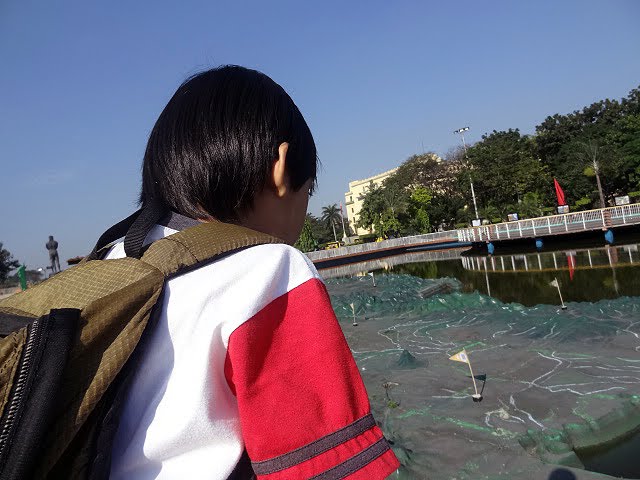
Looking at the relief map of the Philippines


There is a little boy who lives in a shoe :)


He knew all of the creatures by name...


...and climbed each and every one of them


Feeling Steve Irwin


Bowi and Lapu-Lapu!


Bowi took this picture of me.


Short ride in the calesa.


It was hot and we got tired from all the walking. Time for orange juice.


Saturday, January 5, 2013

An email that made me remember these poems

Today I received an email from a certain Mikaela. Here is an excerpt:

Good day to you Ms. Imelda!

Before I start, I must say although there are only a few of your works I could find at the moment, I am already a fan and looking forward to more of your poetry :)

I am currently a student in a university. I have a paper to write on three poems from third-world/Asian poets and originally submitted a proposal with a different set, but when I read your poems "Old House", "Photograph: Father and Kids at Home", "I sing", "Morning Shadows" and "A Little Before Dying" I immediately thought of changing the poems I have to use because they were so close to the heart. I really went through the first five pages of google to search for your works and those were the ones I found.

Now that I've read them over and over again (because understanding poetry takes an immeasurable amount of time for others like me), I still need more information so I could add input to my paper. I know that I'm supposed to be doing this on my own but I'm the kind of reader who gets overly-attached to what she's reading and I really want to know the history behind what I'm reading.

I just had to ask you a few questions because it is intriguing and I'd like to further understand the poetry based from you; if you would do me the honor of answering them.


These are my answers to her questions:

1. Some of your poems are focused primarily on family and within the grounds of their homes; why is that?
In my life, the most meaningful changes and actions happen in the home, with people closest to my heart. My poetry seeks to freeze these moments through words to help me remember, not only the images but more importantly, the feeling. Poetry does a good job of doing this.

2. What is the significance of the number 17 from "Photograph: Father and Kids at Home"? I can't quite put my finger on its juxtaposition to the water meter, and mailbox.
It is the number of the house from my childhood. The same house I grew up in and the place where all of the early milestones in my life happened. This particular poem was written about the photograph.

3. Is the person speaking in first person point of view from "Photograph: Father and Kids at Home" the Father in the title? Is he also the father of his own nephew? Because that's how I understand it especially when you mentioned "naughty grin".
No, the speaker in the poem is the one looking at the photograph, apparently the father's daughter, who is not in the picture. The title is the caption of the photo. The nephew is the observer's nephew.

4. In "A Little Before Dying" was the woman in the poem dying of cancer? She had a slow death, but does the woman have a family? What can you say about its setting?
It was not said what afflicted the woman, it could just be that her loneliness was slowly killing her. It was also not said if she had family, but that she was waiting for "things that will never arrive." And this could be people, or thoughts, or feelings. The setting is obviously the woman's sad and small home, filled with furniture that have sharp corners.

5. "I sing" obviously is about a mother-child relationship; Was the point-of-view based from your own experiences as a mother?
Yes.

6. Where did you find inspiration for writing "Old House"? I'm referring to the dramatic situation and the figures of speech po (I really loved the line "It has memories of lives other than ours"!!!)
After I left my childhood home in "Photograph: Father and Kids at Home" I, together with my ex-husband, lived in a series of rented houses. I could never forget the image of me trying to wipe off the writings on a cabinet door in an old house we rented in Los Banos, Laguna. I wondered then how many lives were lived in that house, how many people it had known, how much sorrow (or joy) it carried, and so on.

7. I have only to choose three, which would you suggest I pick? I love all of them but which are the ones you love most?
Definitely these three: "Old House," "Photograph: Father and Kids at Home," and "A Little Before Dying".

###

In the chaos and fullness of my days in the past months (years?), I have forgotten all about poetry. I'd pick up a poetry book, or read an essay, write a few lines now and then. Sometimes I needed to be prompted by patient friends and FB friends (like Angelo Ancheta!) to write a few poetic lines. Daily. Something that I should be doing, but not. Oh, shame on me!

Happy New Year to the one or two readers of this blog.


Thursday, November 15, 2012

A Visit to the Good Ol' Library

One day he asked me this unexpected question: Mama, what's a library? (As a Waldorf student, Bowi hasn't been exposed to big libraries yet.)

When I was younger, during the pre-Internet era, libraries were a part of my life in a maaaaajor way. I used to go to the British Council, the National Library, Thomas Jefferson on Buendia, and Goethe Institut. These kids are missing a lot, I think. The romance of it all: going through the card catalog, holding the book in your hand, borrowing it from the librarian, returning it late, paying the fee, writing down your notes. It's all part of how I came to love books.

You don't get that by paying Google a visit.

And so I resolved to bring him to a real library. The closest one is the Quezon City Public Library. And guess what? He loved it! He was the only little person there. One of the librarians came up to us to ask what we're looking for.

Oh we're just looking around, I tell him. For his assignment? he asked. No, I said, he just wants to read.


The little guy was literally running around flitting from shelf to shelf like a butterfly darting from one flower to the next.

It was interesting, the crowd that afternoon. There were students, of course, but mostly the library users that day were senior citizens, mostly male. Reading newspapers, listening to audio books (I suppose they're audio books), writing down notes, reading through thick volumes, talking, using their phones. I suppose they were some of those who haven't really transitioned to doing research online.

It was refreshing to see them here. Bowi and all these lolos. Inside this old, not-so-quiet library.


He kept on looking for books on recycling.


I found a book to read, too! :)

Saturday, October 27, 2012

Noah’s Ark in the Age of Reality TV

If something similar to the great 2011 Tohoku earthquake happens in the Philippines, which is not an impossibility, the entire country will be paralyzed for 10 to 15 years. This is the dire prediction of Ed Guevara, a Swiss-Filipino farmer, eco-village advocate, and visionary. “It will take that long, IF we recover at all,” he emphasizes, “but with a government like this, where will you go?”


A dream in his heart

Guevara was born to a poor family that could not afford to send him to college. But he wanted so badly to become an oceanographer and explore the vast seas that he took on a janitorial job just to pay for a scuba diving course. Eventually, he married a Swiss national and they built a family in Geneva. Guevara studied and worked as a banker abroad and lived the good life with his wife and two children. But a thought kept nagging at him: “How could I feel comfortable when I knew that my relatives, like other families in the Philippines, were struggling to survive?”

The birth of GEO Farm and the Eco-village


While in Switzerland, Guevara visited the Health and Nutrition Solvita Exhibit where he discovered the Blue-Green Algae, the Spirulina Platensis. After studying the history and the nutritional effects of Spirulina, an idea was hatched in Guevara’s mind to use this specific type of algae to fight malnutrition in his home country. In 1992, Guevara established GEO Farm in Pangasinan and set up a small-scale Spirulina production facility within a self-sufficient farm. He was convinced that a family-based integrated farm can help countless people escape the eternal cycle of poverty and food shortage.


Tour de force

After helping families and communities by way of conducting training programs on survival, emergency and disaster response, and sustainable communities—on top of his work with the Spirulina farms—Guevara has, after two decades, come to develop his master work: The Rescue Village.

“I’m an emergency guy,” Guevara says, “When I see people doing it wrong, I am so disturbed because I know there is a way to do it better.” He hopes that people would stop depending on the government and start doing what they can on their own. This is the driving force behind his Rescue Village idea, Guevara’s personal contribution to the emergency response efforts in the Philippines.

Disaster response, Philippine style

Guevara laments the fact that in the Philippines, the safety and comfort of people during tragedies are not given enough importance. “Shelters are temporary, and usually these are set up in basketball courts, gymnasiums, or schools,” he explains. “It’s always a stop gap solution.” Classes get disrupted, there are no clean comfort rooms and clean water, and people stay in hot, cramped spaces, making them susceptible to diseases.

The rubber boats that are commonly used by our rescue forces are too expensive, aside from being too bulky for narrow streets. They are also not very sturdy as they could burst and sink easily. “Disaster response training courses don’t empower the people,” Guevara says, “They leave you with a piece of paper and some first aid techniques that are useless when you don’t even have a boat or a life vest.”


The power of media

Media becomes a very powerful tool not only during emergency situations, but also before and after disaster happens. But in the Philippines, unfortunately, mass media do not serve the interests of the masses. According to Guevara, media should know what to do during disasters, and media men should not simply go out and look for sob stories, film people in distress, highlight their tears and suffering. “They should guide the people, tell them what to do,” he says. “Instead of entertaining us, media should educate us.”

Guevara believes that this emotional devastation, which we are so used to, “is a disaster in itself, thank you to all these drama shows”. Instead of empowering people to overcome their problem, they are taught to wallow in their emotions, dragging the entire nation down with them towards helplessness and misery.

Before disaster strikes

Having observed how things are done in Switzerland, where they have supposedly prepared well-equipped relocation areas within their mountains to accommodate 48 million people, Guevara suggests the creation of a rescue village in every community. “And since we know that a typhoon will hit a few days before it actually does, we need to relocate the elderly, the children, the sick, and the pregnant women to safe places—either relatives’ homes or relocation sites—so when disaster hits, we have decreased in half the number of people needing rescue,” says Guevara.

The able-bodied men may be left behind to guard the homes and look after the family’s belongings. These people would most likely be capable of rescuing themselves in case of emergencies.

Improvised drum boat and life vest

Using plastic water drums and PVC pipes, Guevara is able to fabricate low-cost, easy-to-build drum boats that can be used for emergencies. “Ideally, every family must have one boat, since a boat can accommodate six people,” he explains. The boats are easy to maneuver using plastic oars made from the same boat material. They are also stable and durable, with each unit having gone through a wobble test for safety and stability, an overload test, and recovery/flip over test.

Guevara sells his boats for a very low price. He also conducts training sessions on how to build these boats and how to use them properly. “I will not sell a boat without teaching the buyer how to use it, and how to make more boats like it,” he confirms. This is Guevara’s way of empowering communities to rescue their own during emergencies.


Aside from teaching people how to build drum boats, Guevara also shows them how they can make life vests out of cheese cloth and empty water bottles. “With the life vest, non-swimmers could learn to swim in a matter of minutes,” Guevara claims. It is unacceptable to him that over 90% of Filipinos can’t swim, considering that the country is surrounded by bodies of water and many areas are prone to flooding. “If you don’t know how to swim, you’ll simply watch your loved ones drown before your eyes when disasters happen,” Guevara says, “So learn to swim, it will only take a day.”

Ed Guevara believes that once you leave a community with the knowledge to make their own drum boats and life vests, you are leaving them with the necessary skills for survival during deadly floods.

The Rescue Village

The most important part of his recent work in the field of disaster response is the Rescue Village. This is a temporary camp to be established in calamity zones to help in the rescue and rehabilitation of the place and its people. The heart of the village is made of 12 stations (built using 12 40-foot container vans) with each station performing specific functions. For example, one station will carry all the seeds and fertilizer needed to start a garden from scratch. This will provide nutritious food for the Rescue Village staff and the survivors in the event of destruction of all crops and the inability of food suppliers to reach the area.


“I could build a rescue village in just three months,” Guevara declares. The idea is to settle into a calamity zone, help the community on its feet by integrating them into the Rescue Village, and then build a permanent and self-sufficient Eco-village in the area before transferring the mobile Rescue Village to another disaster location. Guevara has created a complete and detailed plan of his Rescue Village project from start to finish.

Inside the rescue village, 20 volunteer experts will be working in different fields of specialization: food production, frozen food maintenance, kitchen work, housekeeping, administration, medical service, powerhouse and water system maintenance, tools safekeeping, etc. A village can accommodate 700 families and 200 staff members. Earth bag homes will be built for each family.

The Rescue Village supplies will be enough for the 700 families for a period of three months. After which, it is assumed that the villagers have been empowered enough to continue on their own. Guevara notes, “We will produce 700 rescuers and 700 rescue boats for each month that the village is in a certain location.” Those rescuers will be coming from the community itself, so when the mobile village leaves the area, the residents would have the necessary survival skills.

In just three months, the village would have rehabilitated 700 families, or 1400 families in six months, and so on. Guevara says, “No engineer is capable of building this in three months—this is nanotechnology—the beds are collapsible, designs are modular.” Guevara will be working with engineers to perfect his designs.

“Let us say a community suffers devastating floods and there are thousands of dead people, the Rescue Village comes in—preceded by bulldozers and other heavy machinery to clear a path and camp—and sets up in the cleared area,” Guevara explains. There will be a holding area where staff members will receive the first 700 families needing rescue. They will be given a warm shower, a clean change of clothes, and assigned to their quarters. “The village cannot accept more than 700 families, otherwise the quality of service will suffer and supplies will run out,” he says, “So the area will be heavily secured and guarded to protect the people inside; everyone will be taught how to defend themselves.”


Survivors and Reality TV

Media could play a great role in Ed Guevara’s Rescue Village Project as it can broadcast, reality TV style, the construction of the first ever Rescue Village. “People will be learning as they are entertained,” Guevara reasons. This, according to him, is the crucial part in the anatomy of a disaster.

“A disaster has three parts: Before, During, and After,” says Guevara. “During” lasts a few seconds or a few hours, “After” and “During” will both depend on the “Before”, or how you prepare for it. “After”, or the effects of disaster, could last for years. It could elicit unbelievable sorrow if inadequate preparation was done, he says. “If you know what you are going to do, if you have prepared for it, you will not panic,” Guevara declares.

The reality TV setup is part of “Before” or the preparation for disaster. Families nationwide will be given information on how they could save themselves and their loved ones in case of disasters. This is the important role of media.

Human dignity

Ed Guevara wishes that people will listen this time and adopt his Rescue Village idea. “Calamities will happen; it is just a matter of time,” he cautions. The system has to be in place when it is needed, and this system has to assure the survival of a good number of people.

“There is no such thing as single survival—I wouldn’t want to live if my family and friends will all perish, or if I’d live for a few days and then die because there is no food,” he shares. The rescue and rehabilitation program, therefore, has to provide survivors with decent living conditions and keep their dignity intact while providing their basic needs.

As far as Ed Guevara is concerned, survival should be complete or there should not be any effort at all. “If there is enough food, decent shelter, safe community, then I will fight to live. After all, this is what survival should be about.”

Monday, October 15, 2012

Bowi's Little Project

About two months ago, I posted an album on my Facebook account with this introduction:

"Bowi wants to do his bit by selling some of his newest artworks. Proceeds will be donated entirely to the victims of the flood. All artworks at P200. Please PM me the titles of the artworks you wish to buy."

Days passed and life happened (i.e., work and ailments) so I was not able to follow up collection and deliveries with his buyers immediately. I finally received most of the payments, added a bit of my own money to come up with the round figure of P1,500.

But since all of the Habagat relief campaigns have ended at this time, I decided to donate the proceeds to Tzu Chi Foundation, which does the same work anyway as a "Buddhist compassion relief foundation". We (Bowi, his buyers, and I as project head) are all assured that the money will go to those who need it. It is an established, well-known, and respected institution. My brother, Charlie, has been with Tzu Chi as a regular employee for quite a bit.

We were invited to become a part of the monthly program for their young scholars. Tzu Chi wanted to tell the children about Bowi's little project to, hopefully, inspire them also to help in their little ways. I am usually not for broadcasting acts of compassion (of course, since it defeats the purpose!) but if it would somehow help other children think that they can do something, even if they are poor and even if it's a small thing, then I'm all for it.


Bowi prepared a "speech" the night before. But he didn't use it anyway.


Bowi arrives in Tzu Chi Foundation, Quezon City. It was a hot day.


Bowi with (from left) cousin Cara, my sister Elmo, cousin Daniel, and my brother Charlie (Tzu Chi employee). Daniel and Cara were there as scholar volunteers, too.


With me (and my new bag)


Bowi's audience


It was a long wait to get to Bowi's segment.


Patiently waiting for his turn.


Bowi: This is for your Eye Center.


Counting the money with Tzu Chi Foundation's CEO Alfredo Li.


Photo op with Tzu Chi Foundation volunteers.


After the program, he was interviewed for a story that will appear in the Tzu Chi Magazine. (Or newsletter? Or website? I totally forgot.)


This little guy didn't need coaching. In all my years conducting interviews, I have never seen a session as refreshing and fun and original as what transpired that day.


See that big smile? He is very happy to help. I only hope you grow up to be a compassionate and loving person, my dear son. I am very, very, very proud of you.